

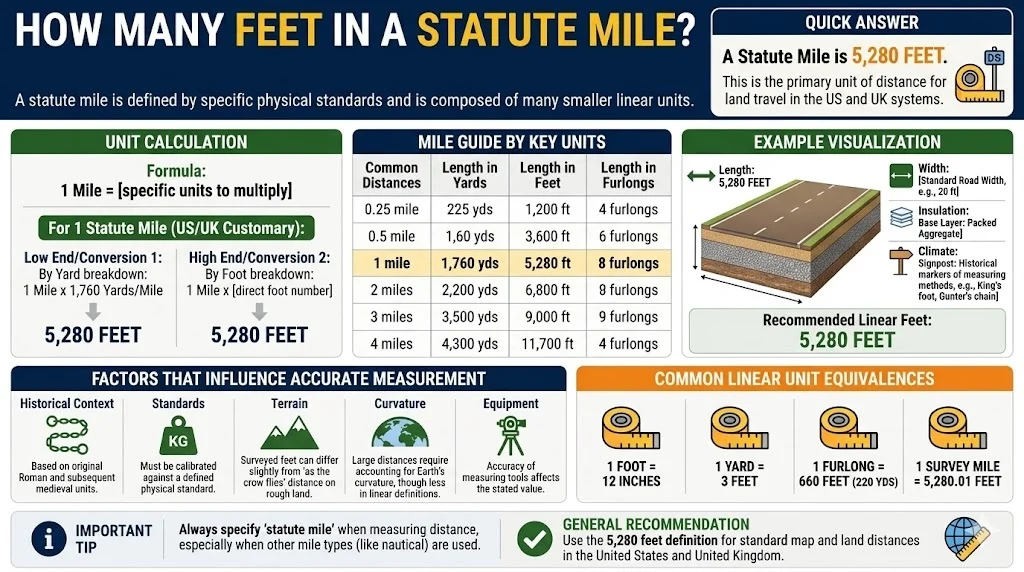
If you have ever asked how many feet are in a statute mile, the simple answer is:
1 statute mile=5,280 feet
This is the standard mile used in:
- The United States
- Road distances
- Running events
- Construction
- Land surveying
The statute mile is different from a nautical mile, which is used in aviation and marine navigation.
Understanding mile-to-feet conversions is useful for:
- Travel calculations
- Sports and fitness
- Construction projects
- Education
- Everyday measurements
In this guide, you will learn exactly how many feet are in a statute mile, where the number comes from, conversion formulas, real-world examples, and common mistakes to avoid.
What Is a Statute Mile?
Before discussing conversions, it helps to understand what a statute mile actually means.
Definition of a Statute Mile
A statute mile is the standard unit of distance used on land in the United States and the United Kingdom.
It equals:
5,280 feet
It is commonly called:
- A land mile
- A standard mile
- Simply “a mile”
When people mention miles in everyday conversation, they almost always mean statute miles.
History of the Statute Mile
The statute mile dates back to England in the 16th century.
The measurement was officially standardized in 1593 under Queen Elizabeth I. It combined:
- Furlongs
- Yards
- Feet
The final definition became:
- 8 furlongs per mile
- 660 feet per furlong
Which equals:
8×660=5,280
That is why a mile contains 5,280 feet today.
How Many Feet Are in a Statute Mile?
The exact conversion is:
1 mile=5,280 feet
This is the standard conversion used in:
- Road signs
- Maps
- Running races
- Surveying
- Property measurements
Quick Answer
| Miles | Feet |
|---|---|
| 1 mile | 5,280 feet |
| 2 miles | 10,560 feet |
| 3 miles | 15,840 feet |
| 5 miles | 26,400 feet |
| 10 miles | 52,800 feet |
Understanding the Mile-to-Feet Conversion
The conversion between miles and feet is straightforward.
Conversion Formula
To convert miles into feet:
Feet=Miles×5,280
Example:
2×5,280=10,560 feet
Why the Number Is 5,280
The number may seem unusual compared to metric measurements, but it comes from historical English units.
A statute mile contains:
- 8 furlongs
- 1 furlong = 660 feet
Therefore:
8×660=5,280
This historical system remains in use today.
Statute Mile vs Nautical Mile
Many people confuse statute miles with nautical miles.
Key Differences
| Type of Mile | Feet | Common Use |
|—|—|
| Statute mile | 5,280 feet | Land travel |
| Nautical mile | 6,076 feet | Aviation and marine navigation |
Which Industries Use Each Type
Statute Miles
Used for:
- Highways
- Running races
- Real estate
- Construction
Nautical Miles
Used for:
- Ships
- Aircraft
- Navigation charts
A nautical mile is based on Earth’s circumference and latitude measurements.
Common Distance Conversions
Understanding related conversions makes calculations easier.
Miles to Feet
Use:
Miles×5,280
Example:
3×5,280=15,840
Feet to Miles
To convert feet back into miles:
Miles=5,280Feet
Example:
5,28010,560=2
Practical Conversion Table
| Feet | Miles |
|---|---|
| 528 | 0.1 mile |
| 1,320 | 0.25 mile |
| 2,640 | 0.5 mile |
| 5,280 | 1 mile |
| 10,560 | 2 miles |
Real-World Examples of a Statute Mile
Seeing practical examples helps visualize the distance.
Running Tracks
A standard outdoor running track is:
- 400 meters per lap
One statute mile equals approximately:
- 4 laps plus a short distance
Mile races remain popular in track and field competitions.
Road Distances
Highway signs in the United States use statute miles.
For example:
- “Next exit 2 miles”
means:
2×5,280=10,560 feet
away.
Walking and Driving Examples
Average walking speed:
- About 20 minutes per mile
Average city driving:
- One mile may take 2–5 minutes depending on traffic
Understanding distance conversions helps estimate travel times more accurately.
Why Understanding Mile Conversions Matters
Distance conversions are useful in many industries.
Construction and Surveying
Builders and surveyors often convert:
- Property lines
- Road distances
- Land measurements
Accurate conversions prevent costly mistakes.
Sports and Fitness
Runners commonly track:
- Mile pace
- Training distance
- Walking routes
Knowing feet per mile helps with interval training and track workouts.
Travel and Navigation
Maps and GPS systems frequently display mileage.
Understanding conversions improves:
- Route planning
- Distance estimation
- Travel timing
Common Mistakes When Converting Miles and Feet
Simple errors can create inaccurate calculations.
Confusing Statute and Nautical Miles
A nautical mile is longer than a statute mile.
Using the wrong type creates incorrect results.
Incorrect Multiplication
Some people accidentally multiply by:
- 500
- 5,000
The correct number is always:
5,280
Mixing Metric and Imperial Units
Miles and feet belong to the imperial system.
Avoid mixing:
- Meters
- Kilometers
- Miles
- Feet
without proper conversion formulas.
Expert Tips for Easy Distance Conversion
Professionals use several methods to simplify conversions.
Memorize Key Numbers
Remember:
- 1 mile = 5,280 feet
- Half mile = 2,640 feet
- Quarter mile = 1,320 feet
These common values help with quick mental math.
Use Reference Points
A football field including end zones is:
- 360 feet long
This helps visualize portions of a mile.
Double-Check Large Calculations
For surveying or construction projects, small conversion mistakes can create major errors.
Always verify calculations carefully.
FAQs
1. How many feet are in one statute mile?
There are:
5,280 feet
in one statute mile.
2. Is a statute mile the same as a regular mile?
Yes. In everyday use, a regular mile usually means a statute mile.
3. What is the difference between a statute mile and a nautical mile?
A statute mile equals 5,280 feet, while a nautical mile equals approximately 6,076 feet.
4. How do you convert miles into feet?
Multiply miles by 5,280.
5. Why does a mile have 5,280 feet?
The number comes from historical English measurement systems based on furlongs and feet.
Conclusion
So, how many feet are in a statute mile?
The exact conversion is:
1 statute mile=5,280 feet
This standard land measurement is used for:
- Roads
- Running
- Construction
- Property surveying
- Everyday travel
Understanding mile-to-feet conversions helps with:
- Distance calculations
- Navigation
- Sports training
- Construction planning
Whether you are measuring a running route, reading highway signs, or working on a construction project, knowing that a statute mile equals 5,280 feet makes distance calculations easier and more accurate.
Discover More Articles
How Many Feet Is 5 Cubic Yards? Complete Guide