

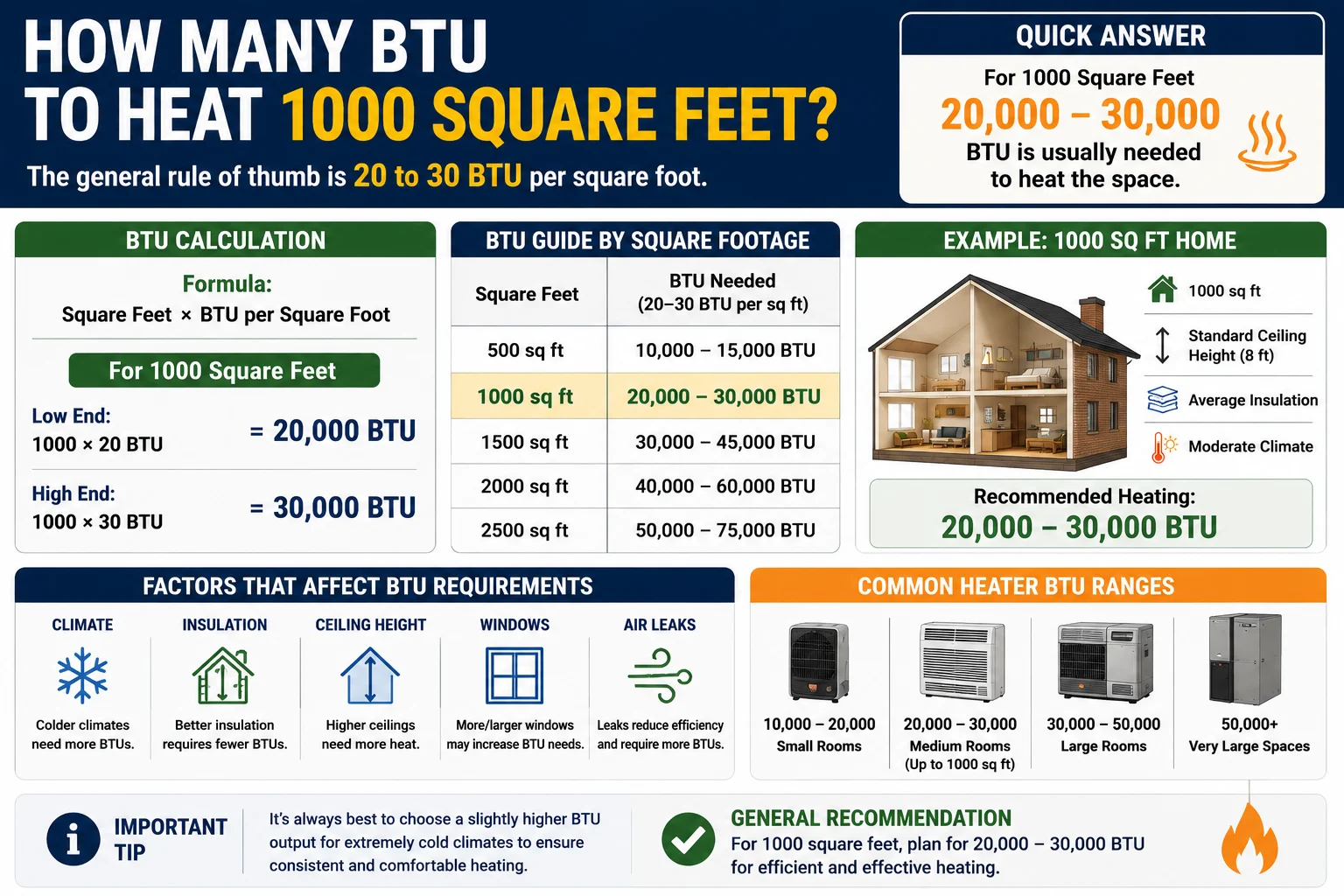
If you’re wondering how many BTU to heat 1000 square feet, you’re likely shopping for a furnace, space heater, or HVAC system.
Choosing the right BTU capacity is important for comfort, energy savings, and heating efficiency. A unit that is too small may struggle to keep your space warm, while one that is too large can waste energy and increase utility costs.
This guide explains everything you need to know in simple language.
Understanding BTUs
What Is a BTU
BTU stands for British Thermal Unit.
It measures the amount of heat an appliance can produce.
The higher the BTU rating:
- The more heating power the system provides
Why Proper Sizing Matters
Correct BTU sizing helps:
- Maintain comfortable temperatures
- Improve energy efficiency
- Lower heating bills
- Extend HVAC system life
How Many BTU to Heat 1000 Square Feet (Exact Answer)
Standard BTU Recommendation
For a 1,000 square foot space, you generally need:
18,000 to 30,000 BTUs
The exact amount depends on climate and insulation.
Climate Considerations
Here’s a basic guide:
- Warm climate → 18,000–22,000 BTUs
- Moderate climate → 22,000–26,000 BTUs
- Cold climate → 26,000–30,000 BTUs
Heating BTU Chart by Square Footage
| Square Feet | Recommended BTUs |
|---|---|
| 500 | 10,000–15,000 |
| 800 | 16,000–24,000 |
| 1,000 | 18,000–30,000 |
| 1,200 | 24,000–36,000 |
| 1,500 | 30,000–45,000 |
This chart gives general heating estimates for homes and rooms.
Factors That Affect Heating Needs
Insulation
Well-insulated homes require fewer BTUs.
Ceiling Height
High ceilings increase heating requirements.
Climate Zone
Cold regions need stronger heating systems.
Windows and Doors
Drafty windows can increase heat loss.
Real Life Examples
Small House
A well-insulated 1,000 sq ft home in a mild climate may only need:
- 20,000 BTUs
Cold Climate Home
A home in a snowy region may require:
- 28,000–30,000 BTUs
Apartment Heating
Apartments often need fewer BTUs because neighboring units provide insulation.
Step-by-Step BTU Calculation
Simple Method
A common estimate is:
- 20–30 BTUs per square foot
Example:
1,000 × 25 = 25,000 BTUs
This provides a good middle-range estimate.
Common Mistakes
Choosing a Heater That Is Too Small
The system may run constantly without properly heating the room.
Oversizing the Unit
Large heaters can waste energy and heat unevenly.
Ignoring Insulation Quality
Older homes may need more BTUs.
Expert Heating Tips
Improve Home Insulation
Better insulation reduces heating costs.
Seal Air Leaks
Windows and doors can let warm air escape.
Use Programmable Thermostats
They help improve efficiency and comfort.
Consider Energy Efficiency Ratings
Efficient systems save money over time.
FAQs
How many BTU to heat 1000 square feet?
Usually 18,000 to 30,000 BTUs
What is the average BTU recommendation?
Around 25,000 BTUs for many homes
Does climate affect BTU needs?
Yes, colder climates require more BTUs
Can a heater be too large?
Yes, oversized units can reduce efficiency
How do I calculate BTUs for heating?
Multiply square footage by 20–30 BTUs
Conclusion
So, how many BTU to heat 1000 square feet? The general recommendation is:
18,000 to 30,000 BTUs depending on climate and insulation
Choosing the right BTU size ensures better comfort, lower energy costs, and more efficient heating performance. By considering factors like climate, ceiling height, and insulation, you can select the best heating system for your space.