
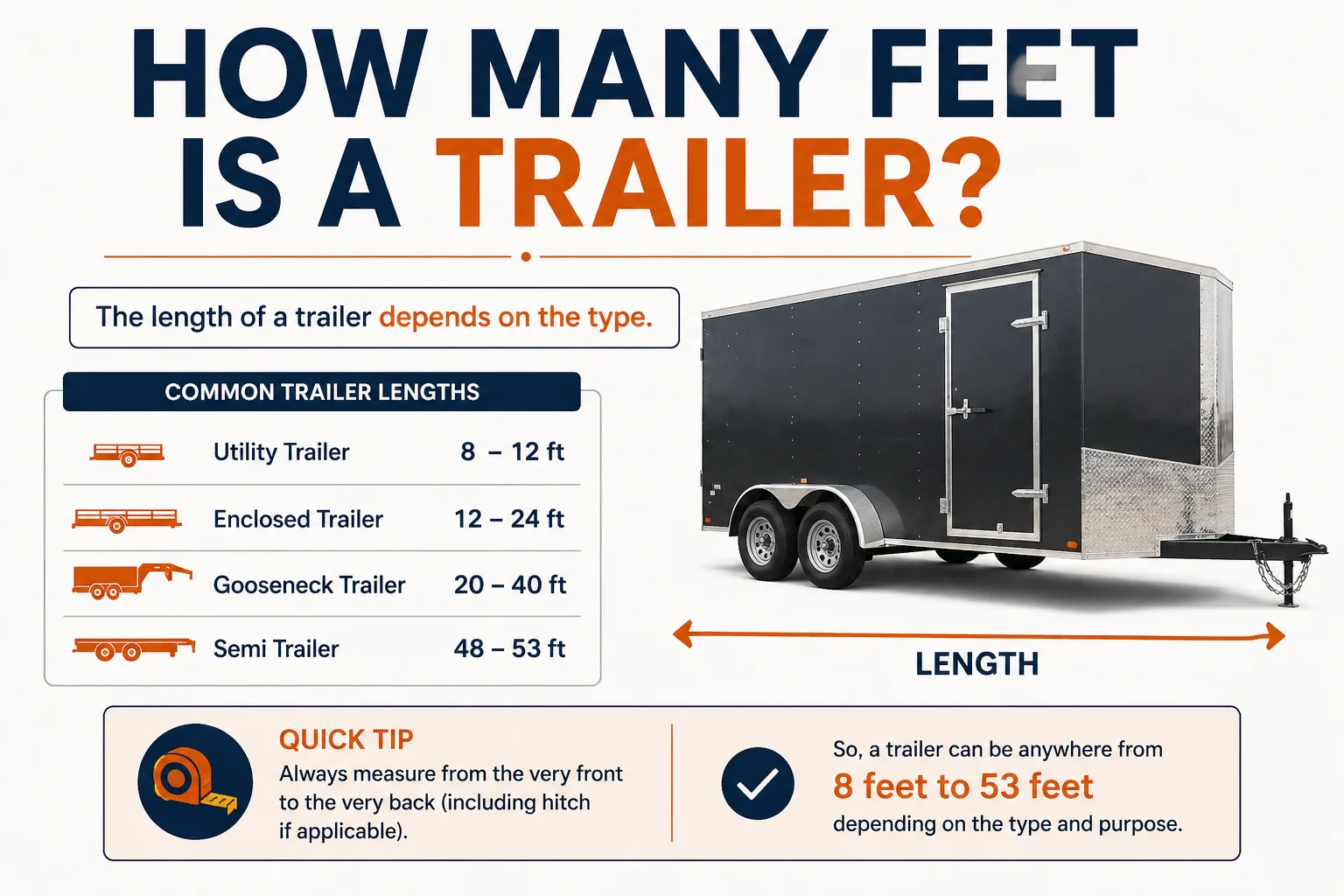
If you’ve ever asked yourself how many feet is a trailer, the answer depends on the type of trailer you are talking about. Trailers come in many sizes, from small utility trailers to large semi truck trailers used for transporting goods across long distances.
Understanding trailer length is important for safety, legal compliance, and choosing the right trailer for your needs. Whether you are hauling equipment, planning a road trip, or working in logistics, knowing trailer sizes can make a big difference.
Quick Answer
There is no single answer because trailers vary in size, but here are the most common lengths
Small utility trailers are usually between 4 and 12 feet long
Cargo trailers range from about 8 to 20 feet
Travel trailers can be between 10 and 35 feet
Semi truck trailers are typically around 48 to 53 feet long
So, when people ask how many feet is a trailer, they are usually referring to a specific type, most commonly a semi trailer, which is about 53 feet.
What Is a Trailer
A trailer is a vehicle without an engine that is pulled by another vehicle, such as a car, truck, or tractor. It is used to carry goods, equipment, or even living space in the case of travel trailers.
Trailers are designed in different shapes and sizes depending on their purpose. Some are small and lightweight, while others are large and built for heavy loads.
Average Trailer Lengths by Type
Different trailers serve different purposes, and their sizes reflect that.
Utility trailers are the smallest type. They are commonly used for carrying tools, small machines, or garden supplies. Their length usually ranges from 4 to 12 feet, making them easy to tow and store.
Cargo trailers are enclosed trailers used for transporting goods safely. These are often used by businesses or individuals moving items. Their length typically ranges from 8 to 20 feet.
Travel trailers are used for camping and living. These trailers can vary greatly in size depending on comfort level and features. Most travel trailers range from 10 to 35 feet in length.
Semi truck trailers are the largest and most commonly seen on highways. These trailers are used for transporting large quantities of goods. The standard length is usually 48 to 53 feet, with 53 feet being the most common in many countries.
Why Trailer Length Matters
Trailer length is not just about size. It affects many practical aspects.
Longer trailers can carry more cargo, but they are harder to maneuver. Shorter trailers are easier to handle but have limited space.
Length also impacts parking, storage, and fuel efficiency. Larger trailers create more air resistance, which can increase fuel consumption.
In addition, road laws often limit how long a trailer can be, especially on highways. This makes it important to know the legal limits in your area.
Common Trailer Length Table
Utility trailers are usually between 4 and 12 feet
Cargo trailers are typically 8 to 20 feet
Travel trailers range from 10 to 35 feet
Car hauler trailers are often 16 to 24 feet
Semi trailers are commonly 48 to 53 feet
This table helps give a quick overview of different trailer sizes.
How to Choose the Right Trailer Size
Choosing the right trailer depends on what you plan to use it for.
If you only need to carry small tools or equipment, a utility trailer is enough. For moving furniture or goods, a cargo trailer is a better choice. If you plan to travel or camp, a travel trailer will suit your needs.
For commercial transportation or heavy loads, a semi trailer is the standard option.
Always consider how much weight and space you need before choosing a trailer. It is better to pick a slightly larger trailer than one that is too small.
Legal Length Limits
Trailer length is often regulated by law, especially for commercial vehicles.
In many regions, the maximum length for a semi trailer is around 53 feet. Some areas may allow longer combinations depending on the type of road and vehicle.
It is important to check local regulations before purchasing or using a trailer to avoid fines or legal issues.
Common Mistakes
One common mistake is assuming all trailers are the same size. In reality, trailer lengths vary widely.
Another mistake is choosing a trailer that is too long for your towing vehicle. This can make driving unsafe and difficult.
People also forget to consider storage space. A large trailer requires more room when not in use.
Expert Tips
Think about your needs before choosing a trailer size. Measure your storage space and make sure the trailer will fit.
Practice driving with a trailer, especially if it is long. Turning and reversing require skill and experience.
Check weight limits along with length. Both are equally important for safety.
If you are new to towing, start with a smaller trailer and move up as you gain confidence.
FAQs
How many feet is a standard trailer?
A standard semi trailer is usually about 53 feet long
How long is a small trailer?
Small utility trailers are typically 4 to 12 feet long
What is the longest trailer allowed?
In many places, semi trailers up to 53 feet are commonly allowed
Are all trailers the same size?
No, trailer sizes vary depending on their type and purpose
What size trailer do I need?
It depends on what you plan to carry and how much space you need
Conclusion
So, how many feet is a trailer? The answer depends on the type, but most trailers range from 4 feet for small utility trailers to about 53 feet for large semi trailers.
Understanding trailer sizes helps you choose the right one, stay within legal limits, and ensure safe transportation. Whether you are hauling equipment or planning a trip, knowing the length of a trailer is a key part of making the right decision.