
One of the most common questions in everyday measurement is:
How many feet are in 1 yard?
Whether you’re working on home improvement, construction, sports fields, or school math, understanding the relationship between yards and feet is essential.
The answer is simple, but the concept behind it is part of a larger measurement system used in the United States and a few other countries.
This guide explains exactly how many feet are in 1 yard, how the conversion works, and why it matters in real-life situations.
Quick Answer
The standard conversion is:
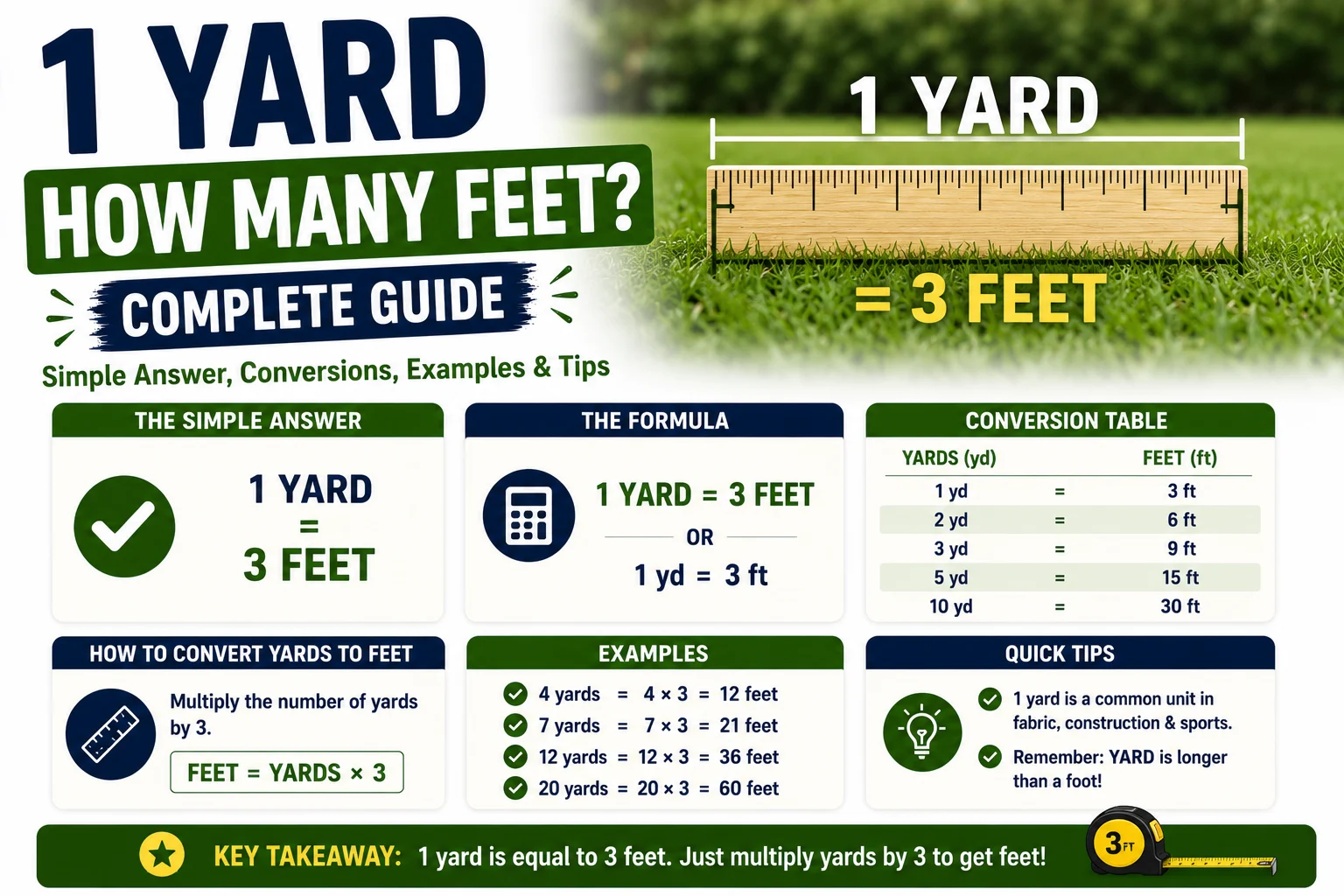
1 yard=3 feet
Final Answer:
1 yard is equal to 3 feet
What Is a Yard?
A yard is a unit of length in the imperial and U.S. customary systems.
It is commonly used in:
- Construction
- Landscaping
- Sports fields
- Fabric measurement
A yard is defined as:
A fixed length equal to 3 feet or 36 inches
What Is a Foot?
A foot is another unit of length used in the imperial system.
1 foot=12 inches
Feet are used to measure:
- Room sizes
- Human height
- Short distances
Yard to Feet Conversion
The relationship between yards and feet is straightforward:
1 yard=3 feet
So:
- 2 yards = 6 feet
- 5 yards = 15 feet
- 10 yards = 30 feet
Why 1 Yard Equals 3 Feet
This system comes from historical measurement standards.
Originally:
- The yard was based on human body measurements
- It was later standardized for consistency
The final agreed value:
1 yard = 3 feet exactly
Yard to Inches Conversion
Since:
- 1 foot = 12 inches
Then:
1 yard=36 inches
Real-Life Examples of 1 Yard
To understand how long 1 yard is, think of:
- A guitar length
- A baseball bat
- Half a door width
It is a moderate length—not too short, not too long.
Yard in Sports
Yards are widely used in sports like:
1. American Football
- Field is measured in yards
- 10 yards = first down distance
2. Golf
- Distances to the hole often measured in yards
3. Track and Field (historically)
- Some older events used yard measurements
Yard in Construction
Builders use yards for:
- Measuring materials
- Planning layouts
- Estimating distances
Example:
- Fence length
- Concrete coverage
- Landscaping projects
Yard in Fabric Measurement
In sewing and tailoring:
- Fabric is often sold by the yard
- 1 yard = standard cut length
1 yard of fabric=3 feet of material
Conversion Table
| Yards | Feet |
|---|---|
| 1 yard | 3 feet |
| 2 yards | 6 feet |
| 5 yards | 15 feet |
| 10 yards | 30 feet |
| 100 yards | 300 feet |
How to Convert Yards to Feet
The formula is simple:
Feet=Yards×3
Example:
5×3=15 feet
How to Convert Feet to Yards
To reverse the conversion:
Yards=3Feet
Example:
9÷3=3 yards
Why Understanding This Conversion Matters
Knowing how yards convert to feet helps in:
- Home improvement projects
- Sports planning
- Buying materials
- School math problems
- Everyday measurements
Yard vs Foot Comparison
| Unit | Length |
|---|---|
| 1 foot | 12 inches |
| 1 yard | 36 inches |
| 1 yard | 3 feet |
Visualizing 1 Yard
Imagine:
- 3 rulers placed end-to-end
- A small desk width
- A large step forward
That is approximately 1 yard.
Common Mistakes
❌ Confusing yards with meters
They are different systems
❌ Forgetting the multiplier
Always multiply by 3
❌ Mixing inches and feet incorrectly
Remember:
- 12 inches = 1 foot
- 36 inches = 1 yard
Yard in Real Projects
Flooring
- Rooms measured in yards or feet
Landscaping
Sports Fields
- Large distances measured in yards
Historical Background
The yard has been used since:
- Medieval England
- Standardized over time for trade
- Adopted into modern U.S. system
FAQs
How many feet are in 1 yard?
3 feet
How many inches are in 1 yard?
36 inches
Is 1 yard bigger than 1 foot?
Yes:
- 1 yard = 3 feet
Why do we use yards instead of feet?
Because:
- Easier for longer measurements
- Common in sports and construction
Conclusion
So, how many feet are in 1 yard?
The answer is:
1 yard equals exactly 3 feet
This simple conversion is one of the most important basics in the imperial measurement system. Understanding it makes it easier to work with distances, materials, and measurements in everyday life from home projects to sports fields and beyond.